

HERITAGE & CULTURE · CUENCA, ECUADOR
Cuenca Historic Center: Why It Is a UNESCO World Heritage Site and What to See
Cuenca’s Historic Center was added to the UNESCO World Heritage List in 1999. The designation applies to the Historic Centre of Santa Ana de los Ríos de Cuenca: a planned urban ensemble, with architecture from different periods and a living urban fabric shaped by cultural exchange. It does not mean that every neighborhood in the modern city, or any particular hotel, has its own individual UNESCO inscription.
WHAT DID UNESCO RECOGNIZE?
The outstanding universal value of a living historic center whose layout preserves Spanish colonial planning and whose architecture reflects adaptations over time.
WHAT DOES THAT MEAN FOR YOUR VISIT?
Walking through its squares, streets, churches and public spaces reveals Indigenous, colonial and republican layers in Cuenca’s everyday cityscape.
Why is Cuenca’s Historic Center a UNESCO World Heritage Site?
UNESCO inscribed Cuenca under cultural criteria (ii), (iv) and (v). Its official description recognizes Cuenca as an example of Renaissance urban-planning principles in the Americas; the fusion of different Latin American societies and cultures expressed in its layout and townscape; and an outstanding example of a planned inland Spanish colonial town.
The grid of streets around civic squares, the relationship with the city’s four rivers and the coexistence of buildings from different periods all help explain this value. The site is not simply a collection of isolated monuments: it is also a lived-in city, with markets, homes, businesses and daily routines.
Which places help you understand Cuenca’s heritage?
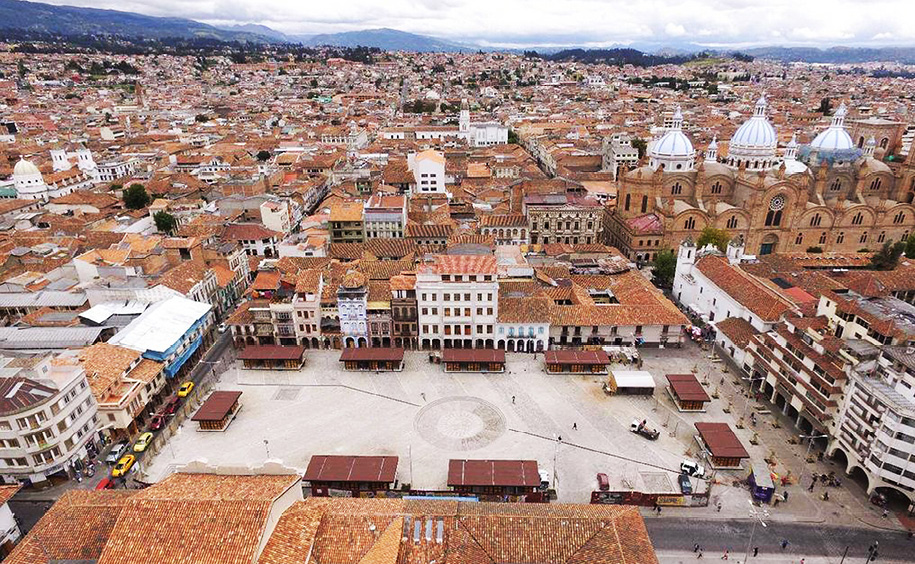
Begin with the public spaces and notice how they connect. Around San Sebastián Square, the plaza, church and surrounding streets show the scale of a traditional neighborhood. Continue toward San Francisco and Calderón Park, where additional squares, façades, churches and civic buildings tell the story of the city and its changes.
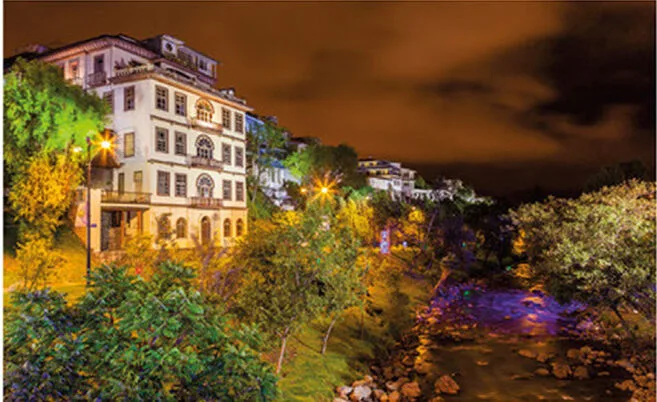
The Cathedral of the Immaculate Conception, known as the New Cathedral, and the Old Cathedral—now the Church of El Sagrario—anchor the urban landscape around Calderón Park. From there, walk down toward the Tomebamba River and El Barranco to see how the terrain and river shape the edge of the historic center. UNESCO also notes that the property includes the Pumapungo archaeological site and corridors corresponding to the town’s historic access routes. To explore them, add Pumapungo Museum and Archaeological Park as a separate visit; check opening hours and access before you go.
A walking route for a first visit
Allow about two hours for an unhurried walk through the central area. The time depends on indoor visits and your pace; this is a suggested orientation, not an official UNESCO route.
- San Sebastián. Start at the square and notice the street layout and neighborhood scale.
- San Francisco and its commercial streets. Walk toward the square and market; look at the arcades and the everyday use of public space.
- Calderón Park. Circle the central plaza and take in the New Cathedral, Old Cathedral and surrounding buildings.
- El Barranco and the Tomebamba. Head down to the river to finish by observing the urban landscape and its connection to the water.
Heritage is also a living city
The best way to experience the Historic Center is not to rush through a checklist, but to alternate landmarks with time to notice details: balconies, courtyards, materials, street names and market life. Be considerate in religious and residential spaces; these places are part of daily life for Cuenca’s residents.
For the official history and boundaries, consult Cuenca’s page at the UNESCO World Heritage Centre. Continue with our guide to things to see and do in Cuenca and our article about where to stay in the Historic Center.
STAY IN THE HISTORIC CENTER
Discover Cuenca from San Sebastián
Hotel Boutique Posada del Ángel is a restored heritage house in the San Sebastián neighborhood, within Cuenca’s Historic Center. It offers a base for exploring the city on foot and returning to a historic setting. The hotel is not individually listed as a UNESCO World Heritage property; its location lets you experience the neighborhood and its architecture up close.
Frequently asked questions about Cuenca and UNESCO
Which part of Cuenca is a UNESCO World Heritage Site?
UNESCO inscribed the Historic Centre of Santa Ana de los Ríos de Cuenca, a defined property that includes the historic core and associated heritage elements. The designation does not automatically cover the entire modern city.
When did Cuenca become a World Heritage Site?
The Historic Center was added to the World Heritage List in 1999.
Why was Cuenca declared a World Heritage Site?
Because of its urban planning, architecture and the exchange of cultural influences expressed in the historic center. The inscription is based on UNESCO criteria (ii), (iv) and (v).
Did UNESCO designate all of Cuenca as a World Heritage Site?
No. The designation applies to the inscribed Historic Center and its buffer zone. It is more accurate to say “Cuenca’s Historic Center is a UNESCO World Heritage Site” than to imply that every part of the modern city has that status.
Is Hotel Boutique Posada del Ángel individually listed by UNESCO?
No. The hotel is located within the Historic Center and occupies a heritage house, but UNESCO has not inscribed it as a separate property. Its location should not be confused with an individual certification or designation.
Primary source: UNESCO World Heritage Centre, Historic Centre of Santa Ana de los Ríos de Cuenca, inscribed in 1999.
Sorry, the comment form is closed at this time.